A compostable bottle is certified to break down.
Just not anywhere it actually goes.
Brand owners are being told that a compostable bottle is the greener, more responsible choice. The certification behind that claim is real. What it does not mention is the single condition attached to it — and why, in the real world, most compostable packaging never breaks down at all.
WHERE THIS CONVERSATION STARTS
Compostable packaging is real. The certifications are legitimate.
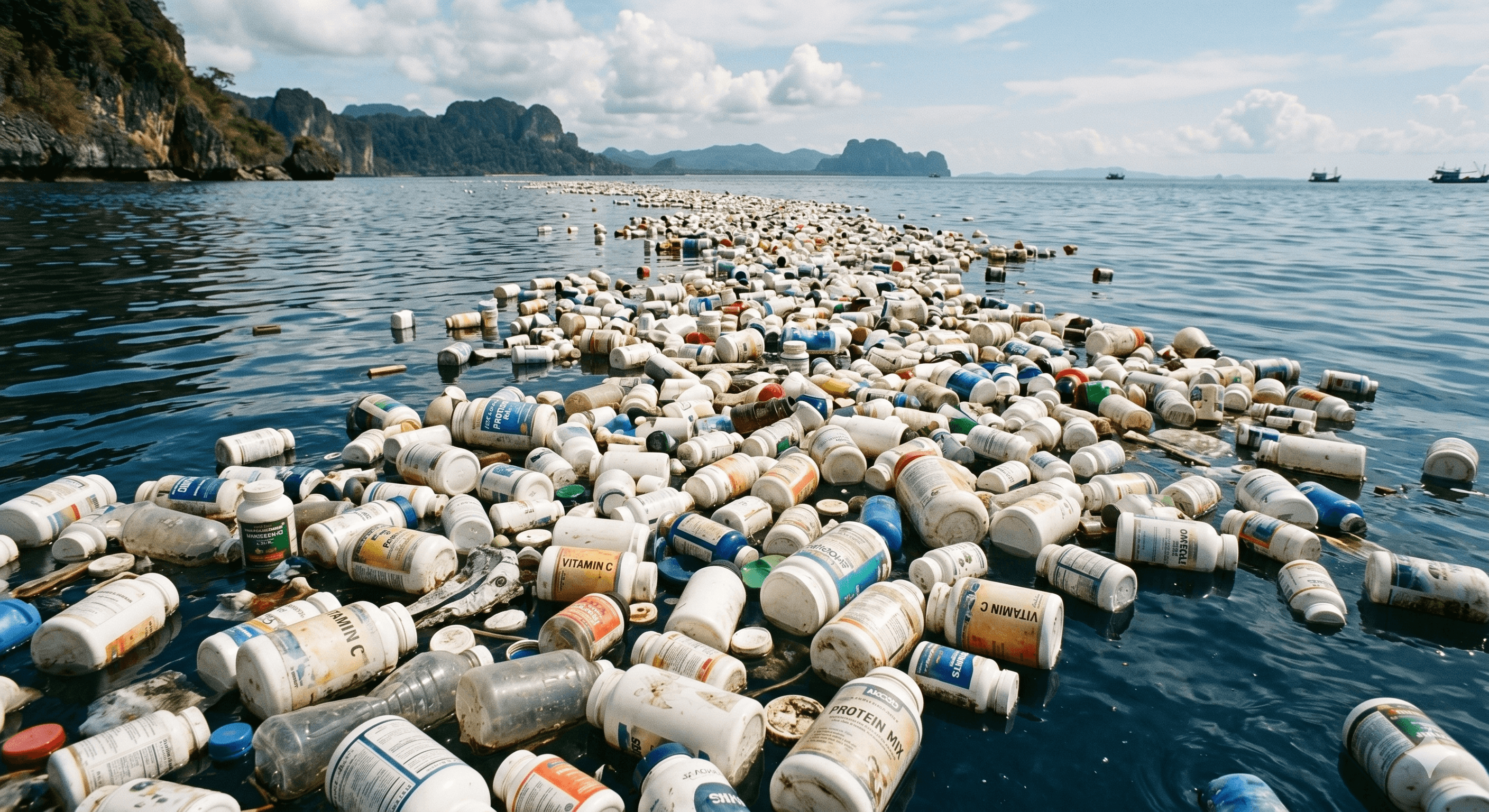
Compostable containers are usually molded from PLA — a plant-based plastic made from corn or sugarcane — and certified under standards such as ASTM D6400 and EN 13432. The pitch is genuinely appealing: a bottle that breaks down completely and leaves nothing behind. Those standards are rigorous, and a product that earns one will do exactly what the certificate says.
It will break down completely — inside an industrial composting facility. That is the condition written into every compostable certification, and it is the part the sales conversation tends to move past quickly.
A certification is not a destination. ASTM D6400 certifies what happens to a material inside a commercial composter. It says nothing about what happens in a landfill, a recycling bin, a roadside, or a river — and that is where the overwhelming majority of packaging actually ends up.
TWO MATERIALS, ONE MARKETING WORD
“It breaks down” can mean two completely different things.
When a supplier says their packaging breaks down, it is worth asking the next question: breaks down where, and under what conditions? The answer separates a material that depends on infrastructure which barely exists from one engineered for the conditions packaging actually meets.
WHAT COMPOSTABLE PLA ACTUALLY IS
Plant-based PLA, certified for industrial composting
- Molded from PLA, a plant-based plastic fermented from corn or sugarcane
- Breaks down only under industrial-composting conditions — sustained 55 to 70°C, managed humidity, and a controlled microbial population
- Outside those conditions — in a landfill, in soil, in water — it stays effectively stable
- Cannot be recycled with conventional plastic; it contaminates HDPE and PET streams
- Typically costs three to five times more than conventional plastic
- Softens near 55°C, which limits hot-fill and warm-climate use
Certified for a place. Not for the real world.
WHAT BIOBOTTLES® ACTUALLY ARE
Oxo-biodegradable HDPE with PlasticIQ®
- Standard food-grade HDPE with a small (∼1%) PlasticIQ® prodegradant catalyst
- Controlled oxidation is triggered by oxygen, heat, and UV — conditions present in a landfill, in soil, and in water
- Once the polymer chains are short enough, common bacteria consume the material into biomass, water, and CO₂
- Recycles through standard HDPE and PP streams — the same bin as any ordinary bottle
- Competitively priced against conventional HDPE, with no filling-line changes
- FDA food-contact compliant; shelf-stable for the full life of your product
Built for where packaging actually goes.
THE DESTINATION PROBLEM
“Compostable” only works in one place. Your packaging almost never gets there.
Here is the fact the compostable pitch depends on you not checking. A compostable bottle only delivers on its certificate if it physically reaches an industrial composting facility. In the United States, the infrastructure to make that happen barely exists.
There is no curbside collection for compostable packaging in the large majority of communities. There is no standard household route that carries a compostable bottle to a composter. And the facilities themselves are both scarce and, increasingly, unwilling to take it.
WHAT THE COMPOSTING INFRASTRUCTURE ACTUALLY LOOKS LIKE
The numbers behind “just compost it.”
INDUSTRIAL COMPOSTING ACCESS · U.S.
46 of ~170
Of roughly 170 full-scale composting facilities in the United States, only about 46 accept compostable packaging at all. The rest handle food and yard waste only. A compostable bottle has nowhere in that system to go.
GEOGRAPHIC COVERAGE
10 states: zero
Ten states have no industrial composting facility whatsoever. Another twenty have only one to three. For most of the country, a “compostable” bottle and a conventional one follow the exact same path.
WHY FACILITIES REFUSE IT
78% turn it away
78% of composting facilities cite contamination from look-alike packaging as the reason they reject compostable plastics. USDA organic rules also bar synthetic PLA from any compost certified as organic. The facilities that exist often will not take it.
And in a landfill — where it actually ends up — PLA does not compost. A landfill has low oxygen, no managed heat, and no managed moisture. PLA is stable under those conditions and can persist for decades. The premium was paid; the benefit was not delivered.
THE SECOND DEAD END
It cannot go in the recycling bin either.
If a compostable bottle cannot reliably be composted, the obvious question is whether it can simply be recycled instead. It cannot. Compostable PLA is not accepted in the standard #1 (PET) or #2 (HDPE) recycling streams.
PLA melts at a different temperature than those plastics, and it does not blend with them. Contamination of as little as 1% measurably weakens recycled PET and HDPE — enough that major recycling organizations treat PLA as a contaminant to be identified and removed, not a material to be recovered.
So a compostable bottle has two failed end-of-life paths, not one. It will most likely not be composted, because the collection and facility infrastructure does not exist. And it cannot be recycled, because it damages the recycling stream. Once you follow the bottle past the point of sale, its realistic destination is the same landfill as everything else — only at three to five times the material cost.
THE PART THE LABEL LEAVES OUT
And when a compostable bottle does break apart, the pieces are not harmless.
There is a quiet assumption folded into the word “compostable” — that the material is gentle and natural, and that a plant-based bottle which escapes into the environment is, at worst, harmless. The sections above show a compostable bottle rarely breaks down. What it can still do is break apart. Like any rigid plastic left in sunlight, soil, or water, PLA grows brittle and fragments into smaller and smaller pieces — without ever returning to nature. Those pieces are microplastic.
And a plant-based microplastic is still a microplastic. That is no longer an assumption. Researchers at the University of Gothenburg ran a controlled, six-month feeding study on PLA microplastics and published the results in the peer-reviewed journal Science of the Total Environment.
PEER-REVIEWED EVIDENCE
The fish raised on PLA microplastics did not behave normally.
UNIV. OF GOTHENBURG · 6-MONTH STUDY
2% PLA diet
Juvenile European perch were fed food containing 2% PLA microplastic for six months— a chronic exposure set to mirror realistic freshwater conditions, not an extreme laboratory dose.
WHAT THE PLA-FED FISH DID
Behavior disrupted
The exposed fish showed a significantly increased stress reaction to the sight of other fish, alongside tendencies toward reduced swimming, tighter schooling, and freezing rather than fleeing when a predator appeared.
WHAT THE RESEARCHERS CONCLUDED
Not a safe swap
The authors concluded that biobased polymers “can pose hazards to the environment just like petroleum based polymers do.” A plant-based origin did not make the fragments safe.
This is the part a compost certificate cannot cover. It describes a best case inside a facility; it says nothing about the bottle that escapes. The evidence now shows that an escaped PLA bottle, once it fragments, carries the very microplastic risk the material was sold to solve. BioBottles® with PlasticIQ® are engineered for the opposite end state — bacterial consumption into biomass, water, and CO₂, rather than a long afterlife as persistent fragments.
A DIFFERENT STARTING POINT
BioBottles® are engineered for where packaging actually ends up.
BioBottles® begin from the opposite premise. Instead of optimizing for a best-case destination that most packaging never reaches, they are built for the destinations packaging genuinely reaches — the landfill, the soil, the waterway — while still recycling cleanly when the system works as intended.
A BioBottle® is standard food-grade HDPE — the same #2 plastic used for ordinary supplement and beverage bottles — with approximately 1% PlasticIQ® technology blended in at production. PlasticIQ® is a Prodegradant BioPolymer Catalyst. It changes nothing about how the bottle looks, fills, ships, or sits on a shelf. It changes what happens if the bottle is ever exposed to the environment.
Controlled oxidation shortens the polymer
When the plastic is exposed to oxygen, heat, and UV light over time, the PlasticIQ® catalyst initiates controlled oxidation. The material's molecular weight drops from over 200,000 Daltons to below 5,000 Daltons— the threshold at which the polymer is no longer too large for biology to act on. These triggers exist in a landfill, in soil, and in open water. They do not require a composting facility.
Bacteria consume what remains
Below roughly 5,000 Daltons, the material becomes a waxy substance that common environmental bacteria treat as a food source. They consume it into biomass, water, and CO₂. The end state is not a smaller piece of plastic — it is material returned to the natural carbon cycle, rather than persistent microplastic fragments.
THIS IS VERIFIED, NOT ASSERTED
The breakdown pathway is documented, tested, and independently confirmed.
ASTM D6954 · 2024 EDITION
Tier 1–3 verified
PlasticIQ® technology is verified under all three tiers of ASTM D6954 — the testing standard for oxo-biodegradable plastics. Tier 1 confirms oxidation, Tier 2 confirms microbial assimilation, Tier 3 confirms no harmful residue remains.
RATE OF BREAKDOWN
~90× faster
Conventional plastic can persist as microplastics for an estimated 400 to 500 years. BioBottles® break down approximately 90 times faster— and they break down by bacterial consumption, not by fragmenting into smaller and smaller permanent pieces.
INDEPENDENT VALIDATION
Third-party tested
The breakdown data has been independently validated by Jordi Labs in the United States, with the underlying d2w-lineage chemistry confirmed by international scientific review. The standards are published; the testing is repeatable.
The European Chemicals Agency defines microplastics as synthetic polymer fragments that resist biodegradation. The entire purpose of PlasticIQ® is to keep packaging from ever becoming one.
TWO HONEST OUTCOMES
Recycle it, or let bacteria consume it. Neither path leaves persistent microplastics.
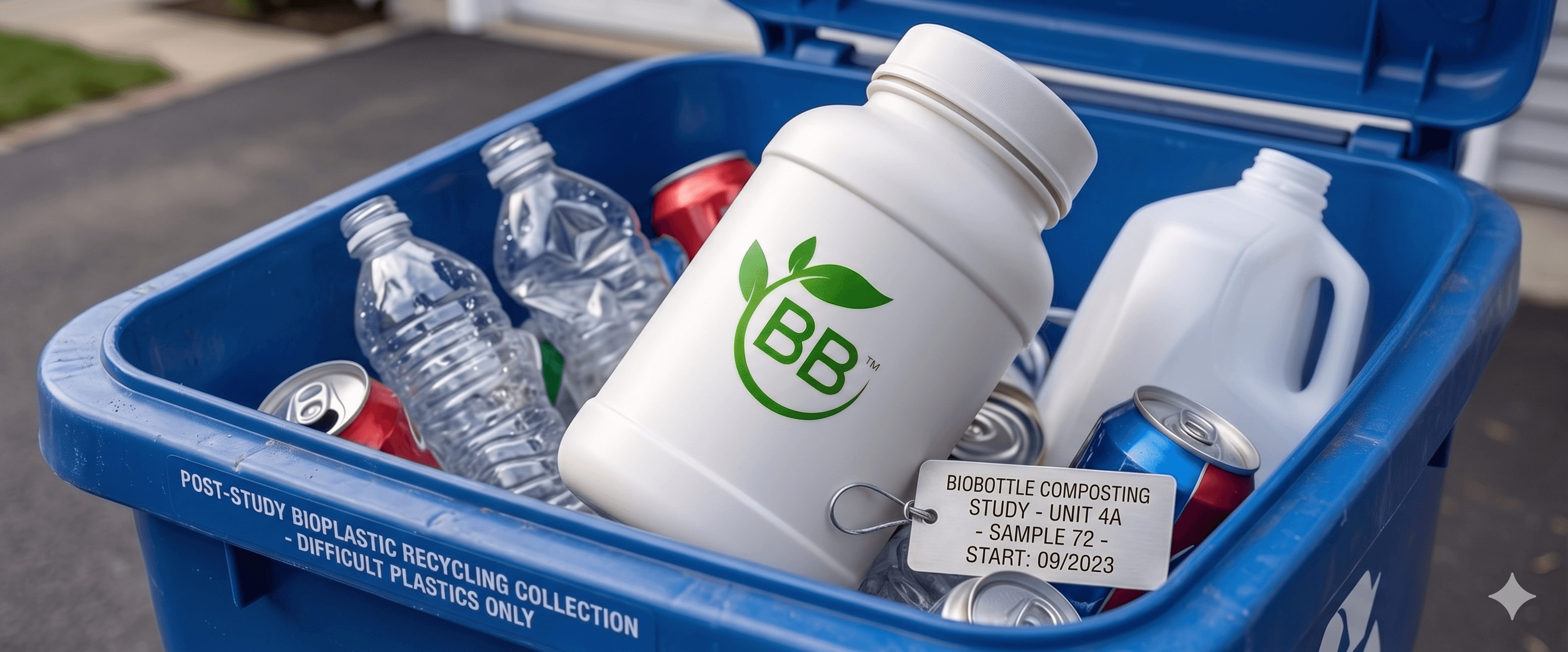
The Path We Want
A BioBottle®is ordinary HDPE. It goes through standard #2 recycling exactly like any other bottle — no special bin, no special collection, no instruction the consumer has to follow. The PlasticIQ® catalyst at roughly 1% does not contaminate the stream. Recycling remains the preferred outcome, and BioBottles® fully support it.
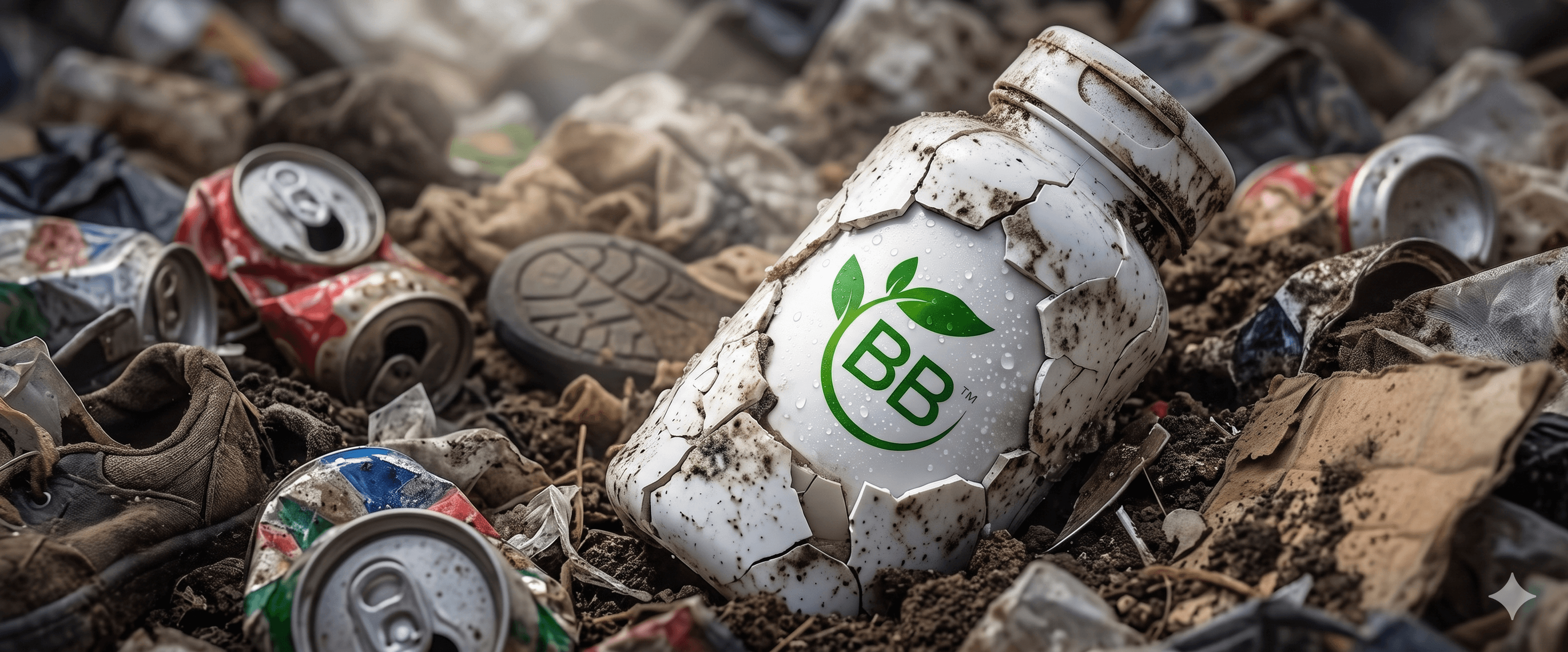
The Path We Plan For
If a BioBottle®misses the bin and ends up in a landfill, a ditch, or a waterway, the chemistry takes over. Oxidation shortens the polymer; bacteria consume what is left. The material returns to biomass, water, and CO₂ instead of persisting for centuries. A compostable bottle in the same landfill simply stays a bottle.
WHAT IT MEANS FOR YOUR PRODUCT AND YOUR LINE
End-of-life is the headline. It is not the only difference.
For the teams who actually have to source, fill, and ship the package, compostable PLA introduces practical costs that go well beyond its end-of-life behavior.
01
Three to five times the material cost
Compostable PLA resin typically costs three to five times more than conventional plastic. That premium passes straight through to unit cost — in exchange, as the sections above show, for an environmental benefit the bottle will most likely never actually deliver. BioBottles® are competitively priced against standard HDPE.
02
A 55°C ceiling and moisture sensitivity
PLA softens at around 55°C, which constrains hot-fill products, warm-climate storage, and summer freight. It is also more vulnerable to moisture over time. HDPE — and therefore BioBottles® — handles heat and provides the moisture barrier that supplements, powders, and liquids depend on.
03
A drop-in change, or a line change
Because a BioBottle® is standard HDPE, it runs on your existing filling and capping equipment with no process changes and no requalification of the line. Switching to a different material such as PLA can require exactly that. BioBottles® — and the matching BioCaps® — are a drop-in.
ADDRESSING THE STRONGEST CASE FOR COMPOSTABLE
“But it is plant-based and renewable.” Does that not count for something?
This is the most genuine argument in favor of compostable PLA, and it deserves a direct answer rather than a dismissal. PLA is made from plants, and a plant-based feedstock has real appeal. But two things have to be weighed against it.
01
Plant-based feedstock has its own footprint
PLA is fermented from corn or sugarcane grown as agricultural monoculture — with the land, water, fertilizer, and pesticide use that implies, and the uncomfortable question of diverting food crops into packaging. “Renewable” is not the same as “low impact.”
02
Carbon claims usually stop at the factory door
The lower-carbon-footprint figures cited for PLA are typically cradle-to-gate — they measure feedstock and manufacturing and stop counting before disposal. For a product whose entire value proposition is end-of-life, leaving out the end-of-life stage is a significant omission.
03
Renewable origin does not change the destination
A plant-based bottle that lands in a landfill behaves like any other bottle in a landfill. The feedstock determines where the material came from. It does not determine what happens after the consumer is finished — and that is the question this whole page is about.
We are not arguing that compostable packaging is a scam. We are arguing that a renewable feedstock is the answer to a different question than the one brand owners are actually asking — which is what genuinely happens to this bottle after someone throws it away.
THE CHOICE ACTUALLY IN FRONT OF YOU
The real question is not which label looks greenest.
It is what genuinely happens to the bottle.
Strip away the marketing language and a brand owner is choosing between three real options for the bottle on the shelf. Only one of them is a question of fact rather than a question of infrastructure that may never arrive.
The bottle you choose
What genuinely happens after disposal
Conventional plastic bottle
Persists for an estimated 400 to 500 years. Fragments into permanent microplastics. No biodegradation at all.
Compostable PLA bottle
Composts only in an industrial facility most packaging never reaches. In a landfill it stays stable. It cannot be recycled. Realistic outcome: landfill, at three to five times the cost.
BioBottle®
Recycles through standard HDPE streams. If it escapes, controlled oxidation and bacterial consumption return it to biomass, water, and CO₂. Verified under ASTM D6954 Tier 1–3.
The compostable bottle is sold as the responsible upgrade over conventional plastic. But if both end up in the same landfill — and the evidence says they usually do — the compostable bottle delivered a premium price and a certificate, and not much else.
BioBottles® are the only one of the three that does not depend on infrastructure that does not exist. Recycling is the goal. Bacterial breakdown is the backup. Either way, the outcome does not require a facility your customer will never find.
WHERE WE ARE STRAIGHT WITH YOU
What we are not claiming.
A rebuttal is only credible if it is honest about the other side. Here is where we agree, and what we will not pretend.
Reduce and reuse beat any end-of-life technology
Using less packaging is better than any breakdown chemistry, ours included. BioBottles® are a safeguard for packaging that escapes — not a reason to use more of it.
The composting standards are legitimate
ASTM D6400 and EN 13432 are rigorous, real standards. Our argument is not with the certification. It is with the gap between that certificate and the infrastructure needed to honor it.
Compostable packaging is right for some operations
If you control the waste stream end to end — a closed venue, an event, a facility with a contracted industrial composter — compostable packaging can work exactly as intended. Most brands shipping to consumers do not have that.
BioBottles® are not compostable
We do not claim they are, and we never will. Compostable means something specific. BioBottles® are a different technology with a different end-of-life pathway.
Recycling is still the first choice
The best outcome for a BioBottle® is the recycling bin. PlasticIQ® exists for the bottles that do not make it there — which, realistically, is many of them.
No packaging is perfect
The honest comparison is not BioBottles® versus a perfect solution. It is BioBottles® versus the conventional and compostable bottles actually on the shelf today. Against those, the choice is clear.
TRUSTED BY BRANDS THAT CHECKED THE DETAILS
The brands that asked the hard questions chose BioBottles®.

See the science.
Then see the bottles.
BioBottles®are not a marketing claim. The chemistry is documented, the ASTM D6954 testing is published, and the validation is independent. We will share all of it — and send you samples your team can put through its own evaluation.