[ CLAIM SUBSTANTIATION ]
Every word on the badge.
With the science behind it.
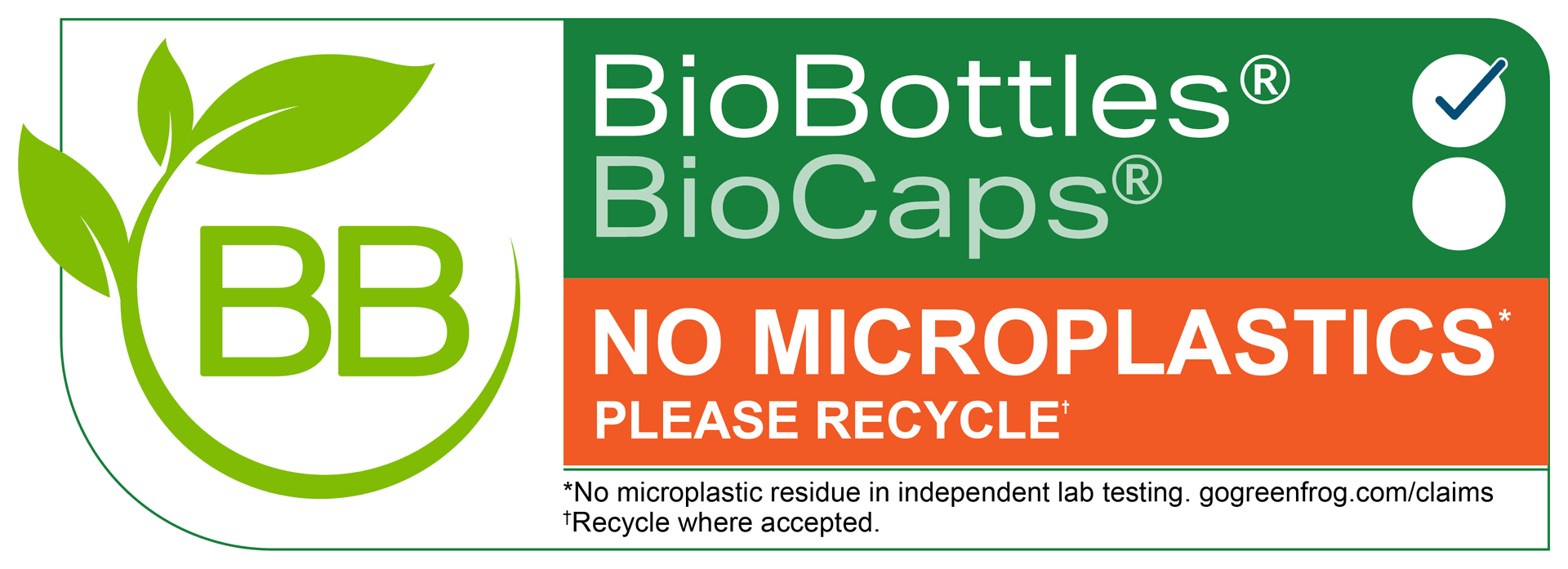
The BioBottles® badge makes a four-word claim. This page is the substantiation map — the testing methodology, the third-party validation, the regulatory framework, and what each beat means in plain English. If you are a regulator, an environmental group, a procurement team, or a curious consumer, the backup is here.
BEAT 1 OF 2
“No microplastics.”
The PlasticIQ® additive is dormant while the bottle is in use — it does not shed microplastics into the product on the shelf, in the supply chain, or in the consumer's hand. After disposal, oxygen, heat, and sunlight trigger oxidative chain scission: the polymer's molecular weight drops from hundreds of thousands of Daltons down past ~5,000 Daltons, at which point common environmental microorganisms metabolize the residue into biomass, water, and CO₂. There are no persistent microplastic fragments left behind because the chemistry does not stop at the fragment stage — it continues through complete bioassimilation.
TEST METHODOLOGY
ASTM D6954 Tier 1–3
The international standard guide for exposing and testing plastics that degrade in the environment by a combination of oxidation and biodegradation. Tier 1 measures oxidation (the chain-scission step). Tier 2 measures biodegradation via CO₂ evolution from microorganisms consuming the oxidized fragments. Tier 3 measures ecotoxicity to confirm the residue and the metabolites are non-toxic to soil and aquatic life.
U.S. THIRD-PARTY VALIDATION
Jordi Labs
Independent polymer-analysis laboratory in Mansfield, Massachusetts. Reviewed our underlying PlasticIQ® chemistry and the supporting ASTM D6954 data and assessed the materials as scientifically sound for the claims made. Report available on request.
INTERNATIONAL CORROBORATION
Prof. Telmo Ojeda (Brazil) · CIQA (Mexico)
Prof. Telmo Ojeda (Federal Institute of Rio Grande do Sul) confirmed that all propositions made for the PlasticIQ® additive are supported by scientific evidence. CIQA (Centro de Investigación en Química Aplicada, Mexico) confirmed biodegradation behavior in their independent testing. Reports available on request.
RETIRED FROM THE BADGE
“Planet friendly.” — and why we removed it.
The badge used to carry a third beat — “Planet friendly.” We retired it. The FTC Green Guides at §260.4 name general environmental benefit claims as the canonical vague claim, and our own consumer testing said the same thing in plainer words: to skeptical shoppers it read as corporate fluff. The claim came off the badge; the substance behind it did not. Here are the four specific attributes — each independently verifiable — that the phrase stood for.
01
Reduced persistent plastic pollution
Conventional HDPE persists in the environment for 400–500 years and fragments into permanent microplastics. BioBottles® break down through ASTM D6954-validated oxidation followed by microbial assimilation, leaving no persistent microplastic fragments — see Beat 1 above.
02
FDA food-contact compliance preserved
The bottle is food-grade HDPE compliant with 21 CFR §§177.1520 (olefin polymers), 178.2010 (antioxidants), and 175.300 (resinous and polymeric coatings). The PlasticIQ® additive is at ~1% concentration and does not alter food-contact safety. The bottle the brand ships is the bottle the consumer can trust.
03
Same-stream recyclability preserved
BioBottles® go through the standard HDPE (resin code #2) recycling stream without contamination or separation. Material Recovery Facilities do not need special equipment, the consumer does not need a special bin, and the bale value of recovered HDPE is unaffected. No disruption to existing recycling infrastructure.
04
No agricultural feedstock impact
Unlike plant-based bioplastics (PLA, PHA), BioBottles® do not require monoculture farming for feedstock — no land-use change, no deforestation pressure, no diversion of food crops. The base resin is conventional HDPE with a small additive load.
BEAT 2 OF 2
“Please recycle.”
BioBottles® are HDPE (resin identification code #2), the most widely recycled rigid-plastic resin in the United States. According to industry data, HDPE is accepted by approximately 90% of US municipal curbside recycling programs — well above the FTC Green Guides §260.12(b)(1) threshold of 60% for an unqualified recyclability claim. The badge says “Please recycle” because we want every bottle that can go through the recycling stream to go through the recycling stream.
California SB 343 framing.California's Truth in Recycling law restricts unqualified “recyclable” messaging unless the product is recyclable in the programs available to ≥60% of the state. HDPE meets this threshold. The fine print on the badge — “recycle where accepted” — gives consumers the locally-correct qualifier in jurisdictions with narrower programs.
Why recycling is the requested path, not just an alternative. Roughly 91% of all plastic ever produced has not been recycled. The biodegradation chemistry described in Beat 1 is the safety net for the bottles that escape recycling — it is not a substitute for recycling. Recycle first. Degradation is what happens when the bottle ends up somewhere it should not.
THE WORDS WE DELIBERATELY AVOID
What we do not claim, and why.
The flip side of substantiation is restraint. A defensible claim is not just the true things we say — it is also the convenient-but-loose things we refuse to say.
“Biodegradable”
BioBottles® are designed to biodegrade — that’s the science. The word itself, though, means something different in every market: the EU applies EN 13432, the US FTC applies §260.8, and Brazil and other regulators each set their own threshold for what the word qualifies as. Rather than lean on a term that travels differently across borders, we name the exact mechanism — oxo-biodegradation verified under ASTM D6954 Tier 1-3 — so the same precise, substantiated claim holds in every country.
“Compostable”
Compostable is a separate standard — ASTM D6400, requiring industrial-composting conditions (50–70°C, controlled humidity, defined timeframe). BioBottles® meet ASTM D6954, not D6400. We do not market them as compostable because they are not engineered for compost facilities.
“Eco-friendly”
Per FTC §260.4 this is the canonical “vague environmental benefit” phrase. We even retired our own brand-voice equivalent — “Planet friendly” — from the badge for exactly this reason. If a phrase cannot survive §260.4 on its own, we do not print it.
“100% recyclable”
Recyclability is program-dependent — no plastic is universally recyclable. “Recycle where accepted” is the legally-honest framing. HDPE acceptance is high but not absolute, and we say so on the badge.
“Breaks down naturally”
Vague verb plus vague adverb. The breakdown is driven by a specific chemical mechanism (oxidative chain scission) followed by microbial assimilation — not a magical natural process. We describe the mechanism, not a feeling.
“Disappears”
Nothing disappears — material is conserved. The polymer is reduced to biomass, water, and CO₂, which are real outputs with real measurable values. Saying “disappears” would imply something the chemistry does not do.
FOR SUPPLEMENT BRANDS
Using BioBottles® on your label?
Brands using BioBottles®, BioCaps®, or the full system have access to a standardized badge family — three product variants (bottle, cap, or combined), each in full color and black & white. The badge is locked: same shape, same brand name discipline, same master claim. We license it through a short intellectual-property agreement that protects your right to use it and our ability to keep the consumer-recognition signal consistent across every brand that displays it.
The brand-asset library — including the six locked badges, the full claim spec, the construction rules, and the do-not patterns — is gated behind that agreement. Contact us to start.
LEGAL & DISCLAIMER
This page is provided for informational purposes. It is a substantiation map of the public claims made on the BioBottles® and BioCaps® badge family, and is not a legal opinion. Customers using BioBottles® or BioCaps® on their own product labels remain responsible for independently verifying that their on-label language is accurate, substantiated, and compliant with applicable regulations in every jurisdiction where the product is sold.
References cited above (ASTM D6954, FTC Green Guides §§260.4, 260.8, 260.12, California SB 343, 21 CFR §§177.1520, 178.2010, 175.300) are publicly available through their issuing bodies. Third-party validation reports (Jordi Labs, CIQA, Prof. Telmo Ojeda) are available on request. BioBottles®, BioCaps®, and PlasticIQ® are registered trademarks of Green Frog Packaging, LLC.
Questions about substantiation, requests for the underlying lab reports, or regulatory inquiries: contact us.